
Investment in vending machines has become an increasingly important business model, evolving from a supplementary retail device in recent years. You don’t have to open a store or hire a lot of people. You just have to pick the right equipment and places and you can make a model that works all the time and makes a profit. However, this does not mean it is a simple money-making tool. Whether you can make money is truly dependent on how deeply you understand this vending machine business.
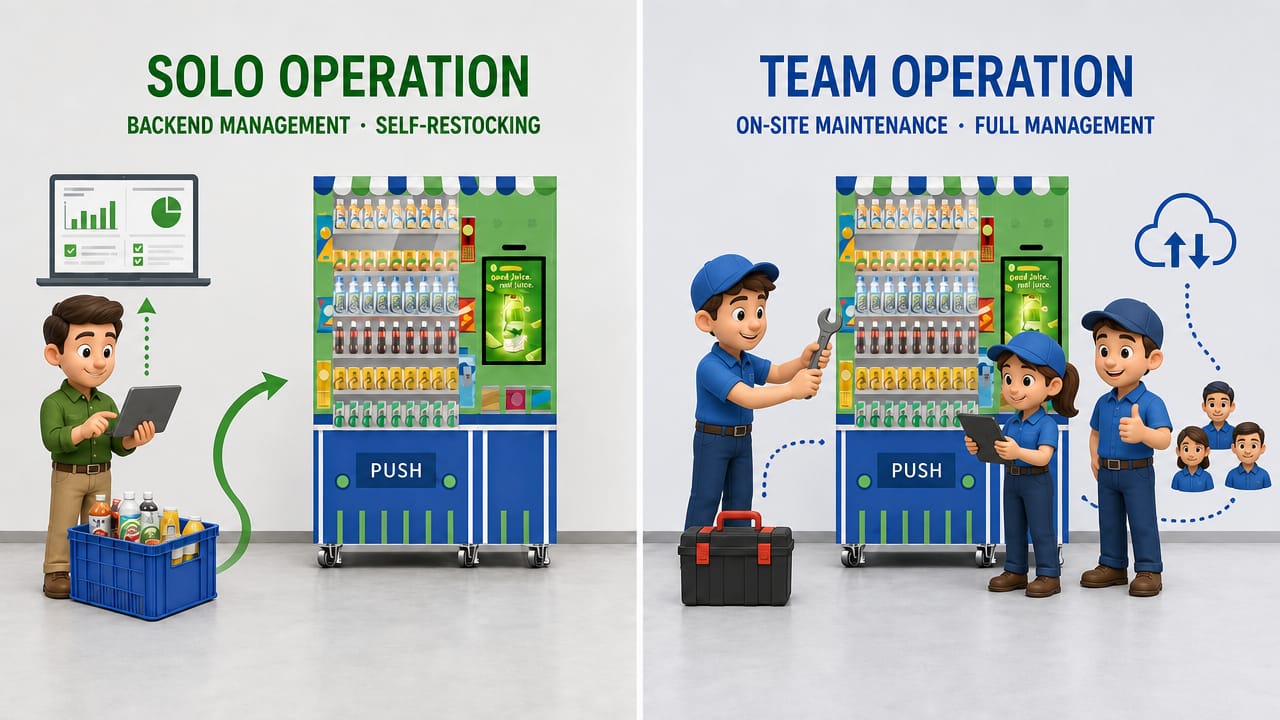
Purchasing the device directly or having it managed by a service provider
When you get into this business, you generally have two ways to go.
Purchasing a Device Directly from the Retailer
That is, you will purchase the equipment yourself, negotiate the prices, handle the replenishment and maintenance yourself, or hire someone to do it. All the profits will belong to you. However, correspondingly, you will also have to bear the initial investment, site selection risks, and the pressures of day-to-day operations.
Service Provider Hosting
You purchase or lease the equipment, and entrust the tasks of site selection, stocking, and maintenance to the professional operation team. You will receive a share according to the agreed ratio. It’s convenient, but the profit margin will be reduced, and your control over the business will also be compromised.
If you value long-term returns and autonomy more, operating the machines yourself is usually a more cost-effective option.You need to assess the time you can dedicate even if you can spare a few hours a week to inspections and restocking it will have a direct impact on the delivery efficiency and stability of the machines. When starting, many people will operate one or two machines themselves first, figure out the site selection logic, product combination, and maintenance schedule, and then consider whether to entrust it to a team for large-scale expansion.
The Main Cost Structure of Vending Machine Investments
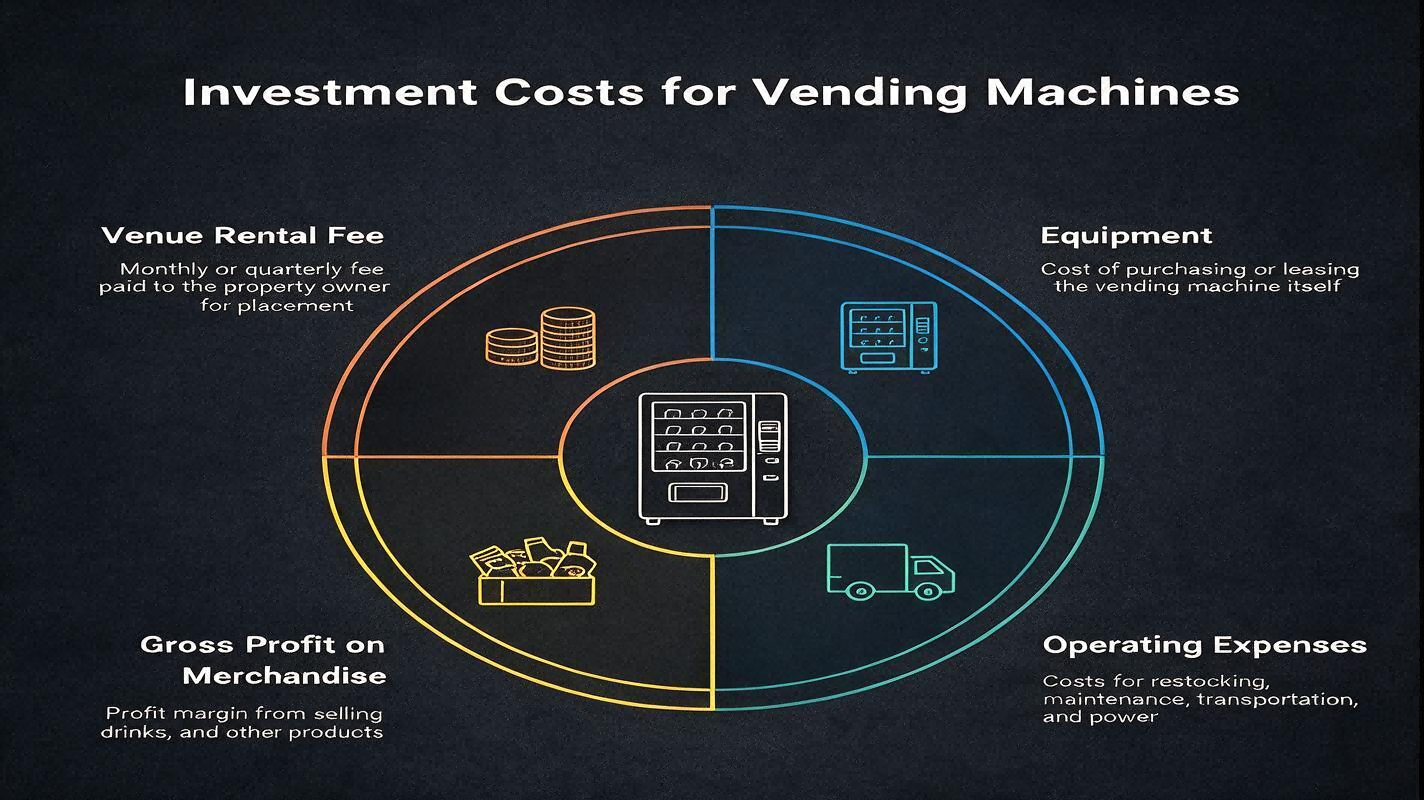
In other words, before you enter the market, you need to understand the cost structure of the vending machine business and understand where your money is going. An investment in vending machines typically includes the following:
Equipment Costs
Depending on the features, a basic, traditional machine may cost around four to five hundred dollars. Meanwhile, a smart model with touch screen, QR code payment and remote monitoring functionality will be more expensive. Meanwhile, a smart model with touch screen, QR code payment and remote monitoring functionality will be more expensive.
Point Cost
Some venues are on a revenue sharing basis, and others charge a fixed rent of a few dozen to a few hundred dollars a month, the key being the quality of traffic.
Operating Costs
These include restocking, logistics, electricity bills, and system maintenance. Beginners often underestimate these costs, but in actual operations, they directly affect the stability of profits.
Cost of Goods
In other words, it’s the margin between your cost price and retail price, which determines how much profit you can make.
Return on Investment for Vending Machine Investments
It is the experience of the industry that a well run machine will normally show a net profit each month, of the order of a certain percent on its cost of investment. That number varies greatly based on product category, foot traffic at the location and pricing strategy. For example, a good model in a location where there is a continuous flow of people can net a few hundred or even a couple thousand dollars a month. But this is a special case and should not be considered a general expectation. The best way is to calculate the conservative payback period before you invest. The usual period for this is 6 to 18 months, if the location is well chosen and the operation is continuous; If the estimated period is far outside this range, re-evaluate the suitability of the location or the model.
Three Key Factors That Determine the Success or Failure of an Investment
If you want to turn a vending machine into a true investment asset rather than a piece of idle equipment, there are three key points you must prioritize.
The quality of the entry point determines the upside potential
The importance of choosing the location for an automatic vending machine cannot be overemphasized. Even if the machine you select is the most advanced, if it is placed in an area with few people and low willingness, the sales volume will be difficult to increase. The same machine, placed in an office building versus on an ordinary street, may yield completely different results. The quality of the flow of people is more important than the number of people.
What you need to focus on are:
- Whether there is a stable and repeatable group of consumers
- Whether there is an immediate demand for consumption
- Whether there is a duration for staying
These factors are far more crucial than the number of people.
The product structure determines profits
Vending machines are not capable of selling everything; instead, they need to select the right products to sell. If the product structure is not reasonable, even if the location is excellent, there may still be a situation where a large quantity of products are sold, but the profits are very meager.
Equipment stability determines operating costs
Model selection is also crucial. If the equipment frequently breaks down, it not only affects revenue but also increases the cost of manual maintenance.
In actual investment, you need to pay attention to:
- Shipping stability
- Payment system compatibility
- Whether the background management can be remotely monitored
The more stable the equipment is, the lower your operating costs will be.
Risks and Misconceptions About Investing in Vending Machines
The risks in this industry do not lie in the equipment itself, but in the operational understanding.
Many new investors in this field tend to underestimate the operational intensity of vending machines and mistakenly believe that simply placing the machines will enable them to operate automatically. In reality, failure to replenish goods promptly will lead to a shortage of products and the loss of orders. Failure to keep up with maintenance will cause malfunctions in the payment system or refrigeration equipment, all of which will directly affect revenue. Another often-overlooked issue is product structure. If you don’t adjust your product selection according to long-term data, then unsold products will always take up machine space and funds. If you can analyze sales data on a regular basis, and quickly remove poor performing products and replenish high demand categories, then the payback period will be greatly shortened. Additionally, not conducting background checks before signing lease agreements, preferring lower rent, and ignoring the quality of foot traffic are recurring problems in many failed investment cases.
If you are evaluating this business, instead of pursuing a large scale from the very beginning, it is better to operate one or two machines solidly first, understand the location selection logic, replenishment rhythm, and cost control, and then decide whether to replicate and expand.
Final Thoughts
Therefore, the true investment logic is not to purchase a machine, but to establish a sustainable operation system. If you are considering entering the vending machine investment field and want a device and solution system that can be cooperated with for the long term, please contact us. Yunyin specializes in the design, research, development, and manufacturing of intelligent vending machines, providing a one-stop solution from equipment to system, making your investment more stable, controllable, and easier to replicate on a large scale.
If you wish to further evaluate the project or obtain a customized investment plan, now is the best time to start.
FAQ
How much start-up capital is generally required for an automatic vending machine investment?
The first investment is model- and scale-dependent. Besides the equipment purchase cost, you also need to reserve the funds for the initial inventory, location rent or share, as well as the operating turnover funds for the next few months. In order to avoid financial strain on the process, it would be advisable to estimate the total start-up cost at 1.3-1.5 times the price of the equipment. If you want a more accurate budget calculation, you can contact us to get a quotation and cost reference according to your machine requirements.
How long does it usually take for an automatic vending machine to break even?
Most machines, if they are in a good location and operated properly, will break even in 6 to 18 months. The time depends on a host of factors, including the product categories, foot traffic at the location, pricing strategies, etc. We recommend starting your estimation with a conservative estimate and adjust according to the actual situation..
Which is better for novices to buy the machine themselves or to hire a service provider to handle?
If you have the time and energy to invest, the long-term returns of self-purchasing the machine are usually higher. If you have no time to manage it, the managed model is more convenient, but the profit will be compressed. Many beginners will choose to operate one or two machines on their own to accumulate experience before deciding whether to scale up.
When choosing a machine, which configurations should you focus on?
You need to determine the functional requirements based on the product category. For new food or beverage categories you need to consider the refrigeration capability and for unmanned retail scenarios you need to consider the payment system and remote monitoring functions. If you are planning to make an investment in a batch or have customization needs, then Yunyin, as a source factory with 13 years of export experience, can provide batch customization and OEM branding solution, which usually have better cost performance.
Is the maintenance cost of an automatic vending machine high?
The daily maintenance cost is mainly the replacement of consumables, maintenance of equipment, and occasional repair of faults. If you choose a good model and perform regular checks, maintenance costs are generally not too high. If you have questions about the maintenance cycle and cost of a particular model, you can always contact the manufacturer for detailed technical support instructions.