
Vending Machine Customer Service: How to Improve Customer Satisfaction and Operational Efficiency
Vending machines can offer round-the-clock access to products, but payment failures, out-of-stock products and equipment faults can all have a negative impact on both customer experience and your revenue. This article discusses daily operations, customer communication, digital management, and manufacturer support. These are ways you can improve the quality of your service, reduce operational losses, and build more stable customer relationships.
How Vending Machine Customer Service Affects Business Performance
Customer service for vending machines is more than simply answering questions and dealing with complaints. It’s the whole process from when customers find products, make payment, pick up products, and get help if they have problems. For operators, service quality is more than just one transaction. It’s about whether the customer will buy again and whether the location will continue to be provided for the operator.
Good Service Increases Customer Repeat Purchases
Customers like vending machines because they want to shop conveniently and save time. When the machine is user-friendly, the payments go smoothly and products are well stocked, customers are more likely to get into the habit of buying. In contrast, if customers suffer from payment failures, products that cannot be retrieved, or equipment that repeatedly stops working, they may switch to nearby convenience stores or other sales channels even if product prices are reasonable.
Besides single-session sales, you also need to see if customers can always get a stable shopping experience. The convenience is why customers usually choose vending machines. The more stable the service the greater the probability that the machine will be part of the daily consumption of customers.
Service Quality Affects Partnerships with Venues
Vending machine operators are serving not only the consumers who are buying products but also the venue partners such as property management staff, mall managers and office building management.
If a machine is frequently at fault, is chronically out of stock or its surroundings are untidy, the people affected are not only buyers. The venue may also receive complaints or have to spend extra manpower to deal with problems. If you can keep the equipment on time, supply the products on time and let the venue know clearly about the progress of problem handling, it’s easier to keep a stable partnership.
In places with many people coming and going, such as airports, hospitals and large shopping malls, the operation of equipment is closely related to on-site management. You can build customer service into your everyday operations and reduce needless operational friction instead of waiting for a complaint to pop up.
Timely Problem Handling Can Reduce Potential Losses
The relationship between customer service and revenue isn’t just that satisfied customers buy again. If equipment faults and you don’t discover it in time, the machine may be unable to sell products normally for a period. Unattended customer complaints can also increase the workload of refund communication, on-site inspection, and repeated repairs.
For you, truly effective customer service is identifying problems as early as possible, determining handling priorities, and letting customers know what will happen next. It doesn’t necessarily require a complex service system, but it does require clear processes and consistent execution.
The Most Common Customer Service Problems in Vending Machine Operations
Payment Succeeded, but Products Were Not Delivered Normally
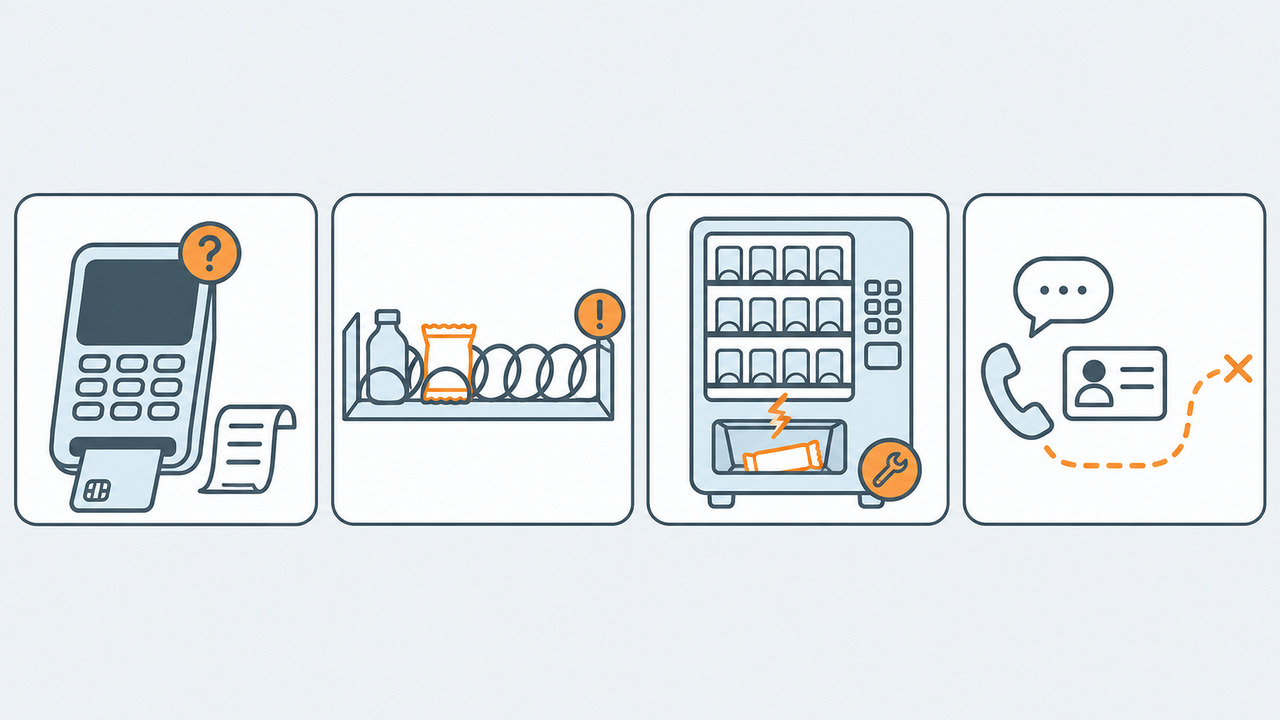
Payment problems are one of the key situations to handle in vending machine operations. If customers complete payment but don’t get the product, or the transaction status is unclear, they may suspect they were double-charged or lost money.
When encountering such problems, you need to first record the transaction time, equipment number, product information and payment method, and then check the payment record and equipment transaction status. The refund should be processed based on the actual payment channel and transaction record, and the customer should be informed of the next steps.
To lower communication costs, contact information should be clear and easy to find on the machine. You can also develop a single complaint registration process, allowing customers to report issues via telephone, email or instant messaging channels. In this way you can obtain the necessary information and avoid the customer repeating the same story over and over again even if you are not at the equipment site.
Products Out of Stock or Products Differing from Expectations
Usually, customers know what they want before they get to the machine. If popular products are frequently out of stock, or the information displayed by the machine does not match the actual products, customers can hardly have an ideal shopping experience.
You need to combine sales records with inventory checks to avoid problems like this. You can regularly check sales for different products, compare sales performance by locations, time periods and product type and then adjust restocking quantities and product mix. If you restock by fixed amounts and do not take sales into account, you can find yourself with best-sellers out of stock and slow-moving products taking up space.
Of course, product selection also needs to match the operating scenario. Customer needs differ across schools, hospitals, hotels, and factories. Adjusting the product mix according to the target population can reduce situations where customers can’t find what they need, and also make limited channels or storage space more reasonably utilized.
Equipment Faults or Un-Smooth Operation
Problems such as unresponsive screens, stuck products, scan failures, or payment interfaces that can’t be entered may all prevent customers from completing purchases. For unattended equipment, there is often no staff to provide immediate help when problems occur, so the fault handling mechanism is especially important.
You can arrange handling order by impact level. Equipment that can’t transact at all needs priority inspection; if only individual products can’t be sold normally, you can first confirm whether the problem is concentrated in a certain channel or product position, then decide whether to pause sales of that product.
During handling, you need to record the time the fault occurred, its manifestation, investigation results, and repair status. If a problem recurs, you shouldn’t only do temporary handling each time, but further check whether there are persistent problems in equipment parts, operation processes, or maintenance arrangements.
Customer complaints are a big part of determining whether equipment needs maintenance, but you shouldn’t rely solely on them, either. Regularly check the operation of your equipment, cleanliness, payment modules and product dispensing mechanisms. In this way you can take action before problems impact more customers.
Customers Don’t Know How to Get Help
Even if you’re willing to handle problems, if customers can’t find contact information, service can’t effectively begin.
It’s recommended to display valid contact information prominently on the machine and explain as much as possible what information customers need to provide, such as machine number, transaction time, problem type, and related transaction vouchers. The clearer the information, the easier subsequent verification becomes.
At the same time, different problems should have corresponding handling processes. Payment exceptions need transaction record verification, equipment faults need investigation arrangements, and product quality problems may involve product batches and supply sources. Classifying problems can avoid all complaints entering the same handling loop, reducing ineffective communication.
How to Build a More Effective Vending Machine Customer Service Process
First Establish a Clear Complaint Handling Mechanism
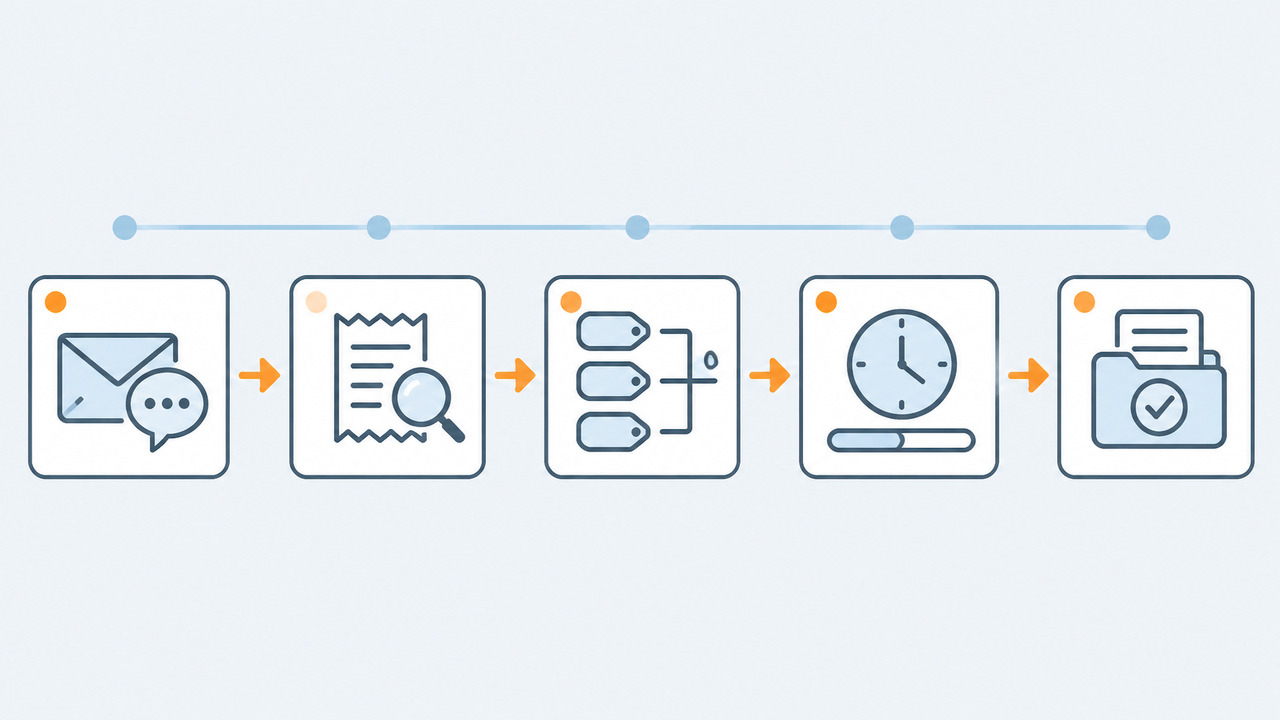
Customer service can be broken down into several stages: receiving the problem, verifying the information, classifying the problem, following up on the problem, and recording the results. It’s not a hard process but it allows you to make sure you’re not missing complaints and it makes it easier to handle more equipment as business grows.”
When you get a problem, first check what situation the customer faced. Then collect the information needed to deal with it. For problems that can be solved by operational guidance, give guidance immediately. For problems that require on-site inspection, make clear the follow-up arrangements. For payment or refund problems, verify according to transaction records.
You should also keep customers posted on the current handling progress for problems that cannot be temporarily solved, instead of letting them wait. Every problem must have clear follow-up responsibility but specific response and resolution times can be determined by problem type, equipment location and service arrangements.
Let Customers Know the Handling Progress of Their Problems
Customers don’t necessarily require every problem to be solved immediately, but they usually want to know whether their feedback was received and what to do next. So your service communication needs to achieve three points: confirm the problem, explain the handling method, and feed back the handling result. When maintenance personnel need to come on site, you can first inform customers that the fault has been recorded and explain the follow-up inspection arrangement. For problems involving third-party payment channels, you should explain what information verification needs, and through which channel refund progress should be confirmed.
If you operate multiple vending machines, it’s recommended to set an independent number for each device and correspond complaint records to equipment locations. This way, staff can locate problems faster and also judge whether a certain location has recurring faults.
Adjust Service Methods Based on Customer Feedback
“Simply solving a customer complaint is not enough; you need to use that as a basis for improving how you do business. You can regularly count types of complaints, results of handling and recurring problems. You will see which problems are most common, which machines need priority maintenance and which improvement measures actually reduced complaints.
These records allow you to move gradually from reactive problem solving to proactive service improvement.
Using Vending Machine Management Platforms to Improve Service Efficiency

Manual checks can still be manageable with only one or two machines. But once machines are installed in various cities, malls, hotels or office buildings, relying only on site inspections and manual information collection makes management more difficult. Digital management can help you understand business conditions sooner and provide a basis for customer service.
Understand Customer Needs Through Sales Data
Sales data can help you judge which products are more popular, which machines’ sales performance has changed, and whether demand differs across locations. If certain products keep selling well on specific machines, you can appropriately increase quantities in subsequent restocking; if a certain category has long had low sales, you can evaluate whether to adjust the product mix.
This kind of analysis can improve product supply and reduce situations where customers arrive at the machine and find products out of stock. However, a sales decline doesn’t necessarily mean lower customer demand; it may also relate to stockouts, equipment faults, or payment exceptions, so you also need to make comprehensive judgments combined with information such as inventory and equipment status.
Optimize Restocking Arrangements Through Inventory Information
Customer service is directly related to inventory management. Whether customers can smoothly buy what they want depends on whether products are adequately stocked. On the management platform you can see your inventory, determine which products are running low, and prepare the next restocking depending on the speed of sales. If the machines are spread across multiple sites, you can also compare consumption by site, so that not all machines are on exactly the same restocking strategy.
Troubleshoot Problems Through Equipment Status and Sales Changes
If a machine is not selling well, you can investigate by correlating equipment status, inventory and transaction records. Also, having the information from different machines in one location helps you determine which problems need to be tackled first. Where faults cannot be rectified by remote checks only then arrange for staff to inspect on site reducing unnecessary attendance.
Reduce Management Work Through Remote Price Adjustment and Reports
In case you have to change the prices of products, remote price adjustment can decrease the workload of adjusting each machine on the site. Sales reports can help you summarise the operating performance of different machines, which can be used as a reference for product adjustment, inventory arrangement and operation review. These functions are not only for sales management, but also indirectly affect customer experience. Timely pricing updates can help you receive fewer questions about pricing inconsistencies and better operational data can help you spot possible problems that impact customer purchases.
Final Thoughts
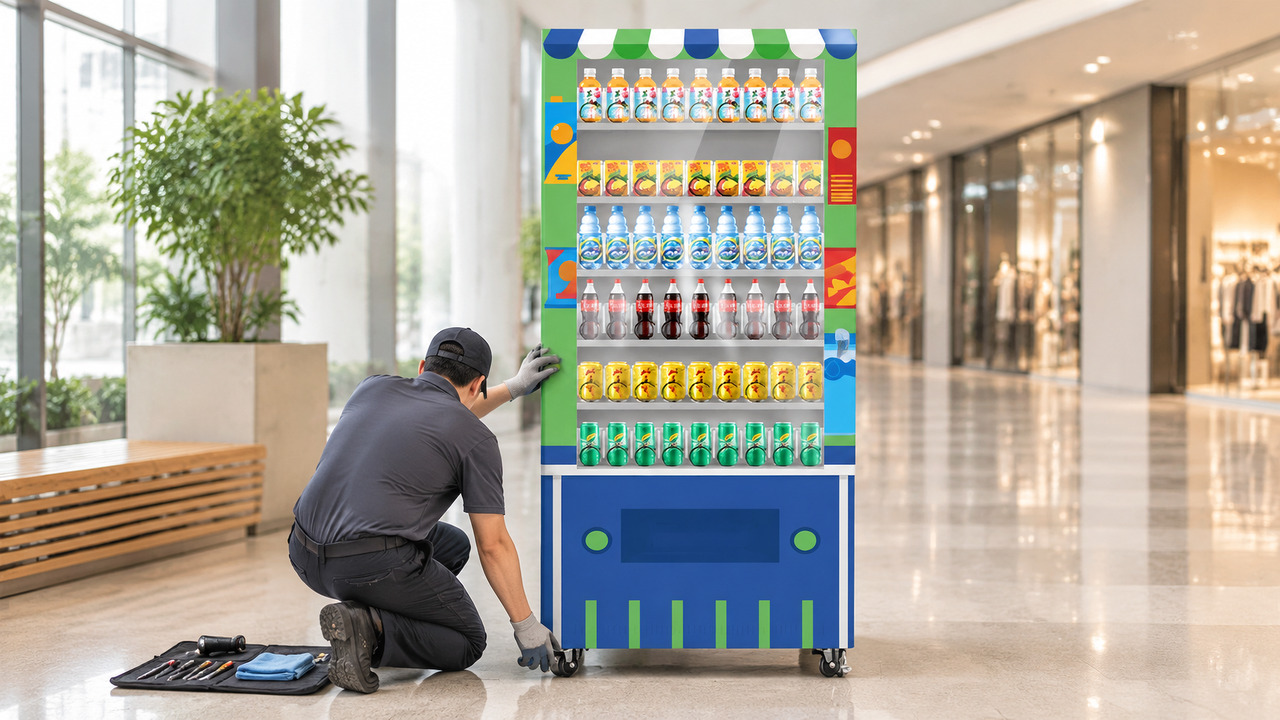
The essence of vending machine customer service is to make the purchase process smoother, the operation of the machine more stable, and the problem handling more timely. You could improve operational efficiency gradually with data management and full after-sales support. Yunyin provides intelligent vending machines, remote technical support, operation training and repair assistance to help you plan suitable unmanned retail solutions for different operating scenarios.
FAQ
What exactly does vending machine customer service include?
Vending machine customer service includes handling payment exceptions for end consumers, out-of-stock feedback, equipment fault handling, refund communication, and usage guidance, as well as installation and commissioning, operation training, spare parts supply, and technical support between operators and equipment manufacturers. You need to establish corresponding service processes based on your business model, ensuring problems are received and followed up by someone.
How can I reduce customer complaints about vending machines?
You can start with four aspects: equipment maintenance, product supply, payment process, and information display. Regularly check equipment, order stock based on sales, ensure that operation instructions and contact information are clear, and respond promptly to feedback from customers. At the same time it is more effective to keep track of the types of complaints and the recurring problems and to regularly review the causes than simply fix the problems after the complaints have occurred.
When purchasing a vending machine, how should I evaluate the manufacturer’s after-sales service?
It is advisable to pay attention to the existence of installation guidance, remote commissioning, operation training, spare parts supply, repair guidance by the manufacturer, and to confirm the communication channels and handling processes in case of technical problems. For overseas projects, find out about remote support methods in advance as well as the possibility of arranging on-site repairs depending on the project conditions. Yunyin can provide remote technical support, installation guidance, operation training and repair assistance; specific service arrangements can be confirmed during procurement communication.
What technical support can I get when purchasing vending machines overseas?
For overseas projects, communication is usually via email, phone and WhatsApp, and remote technical guidance or commissioning is available as required. Regarding on-site inspection and maintenance, it shall be confirmed according to the location of the equipment, fault situation and project arrangement. Yunyin offers remote support for overseas buyers and can arrange on-site services according to project conditions to help you solve technical problems arising during the installation and operation of equipment.
Can vending machine manufacturers provide spare parts and operation training?
You can treat spare parts supply, repair guidance, and operation training as service content to confirm before purchase. Operation training helps you master the basic use of the equipment and management backend; spare parts and repair guidance help with fault investigation and subsequent maintenance. Yunyin provides spare parts supply, repair guidance, and operation or backend training support; specific arrangements can be confirmed through communication based on equipment model and project needs.
What vending machine projects can Yunyin support?
Yunyin is engaged in the design, research, development, production and sales of smart vending machines and provides equipment and unmanned retail solutions for various operating scenarios. If you need to deploy equipment in Airports, Hotels, Hospitals, Office Buildings or any other commercial venues, we can discuss model selection according to the products sold, installation environment, payment needs and operation methods. Yunyin can also help you plan the arrangement from equipment procurement to later operation, provide installation guidance, remote technical support, operation training and repair assistance.